Tuesday, April 23, 2013

Lee deForest - the "missing" archive

This is Lee deForest, a radio pioneer who invented, among other things, the audion vacuum tube, used in early radio amplification. He also found himself constantly involved in lawsuits and hostile takeovers of his businesses, partly because of his own lack of any real business sense, partly because he sometimes surrounded himself with shady characters, and partly because he patented a few things that in the proper light might seem to have been "borrowed" from other inventors.

In 1906 he was doing well making radio receivers for the military that used a certain detector that bore some similarity to one patented by another radio pioneer, Reginald Fessenden, who sued deForest. Fessended won, and deForest had to scramble to find another detector. He had invented but not perfected the audion. Fortunately for him retired Army general Henry Harrison Chase Dunwoody, who was a vice president of deForest's company, had just invented the carborundum radio detector, arguably the first patented practical semiconductor device. It didn't work very well, but they hired a consultant, G. W. Pickard, who redesigned it and made it a very successful detector. It saved the company, but deForest was kicked out anyway. the only thing he was able to take with him was the patent for his audion tube, which the directors deemed worthless. Eventually it would make a fortune for deForest.

Very little is known about the relationship between deForest and Dunwoody, or the details of how the carborundum detector was discovered. If Dunwoody kept notes they are lost, and deForest barely mentions Dunwoody in his writings (not surprising; deForest was a shameless self promoter). He did write one letter in his later years regretting that Dunwoody, long deceased, never got the credit he deserved.

I have been searching for years for any links between deForest and Dunwoody to flesh out the story. Members of Dunwoody's family have searched in vain (so much appreciation to them!), deForest's works at the Library of Congress have been scoured, but nothing. I had just about given up when I found, by accident, that the History San José archives houses a large collection of deForest materials, including his research notes from the period. I hadn't noticed them before because they had been stored until 1991 in one archive  then moved, effectively without a home, until they were added fairly recently to the History San Jose collection. The archivist was kind enough to offer to dig through the collection to see what he could find. Stay tuned...

Sunday, January 27, 2013

Radios, airplanes and WWI

This is from a folder of notes by G. A. Wieczorek, a Signal Corps officer during WWI and an instructor at the Second Corps Signal School at Chatillon-sur-Seine. These are notes regarding using radio with observation from aircraft, one of the first military uses for both radio and airplanes.

Radios evolved dramatically during the first World War, partly because they needed to be small and light enough to be crammed into aircraft. Still they were fiddly things, and flying a wood and canvas plane while constantly adjusting spark gap radio equipment AND trying to avoid being shot down was no small task.


This definition of radio from the 1918 Ellington Field yearbook sums up the situation well.

Radio is the science whereby a pilot, in the leisure seized in the quiet moments of combat with eighteen enemy planes, while under a rattling archie fire, communicates to his commander the complexion, civil occupation and beer preference of a Hun 15,000 feet below.
"Archie" was British (and later American) slang for anti-aircraft guns.

Friday, January 25, 2013

Weather Forecast

From a 1944 Beachhead News, an Army one sheet newspaper printed on the Anzio beachhead in 1944.

Friday, November 2, 2012

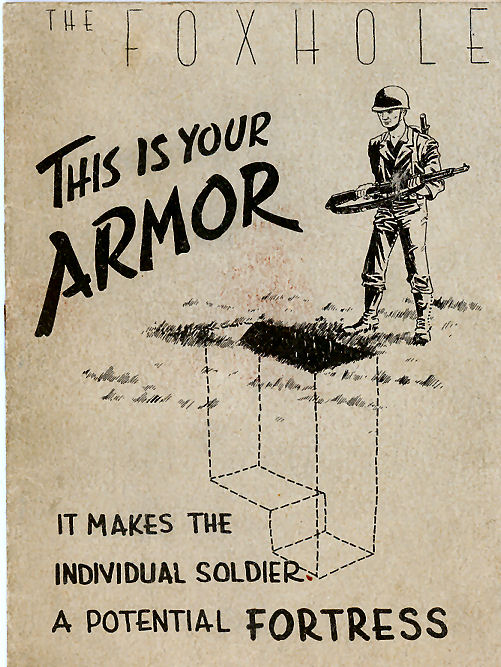
This is your armor

As promised, the rest of "The Foxhole".


How to dig a foxhole


I came across this little pamphlet, “The Foxhole: this is your armor”, some time ago but I hadn't identified its origin until recently. There is no date inside and no publishing information, but it does have the look of a WWII document. A few days ago I took a closer look at the tiny logo on the back.

It’s really tiny – not quite half an inch wide – but once magnified I could see plainly that it says “1st. A/B EAUTC – Reproduction Section”. 1st A/B indicates that it is a unit of the 1st Air Force, one of the first four numbered US Air Forces. They have a long history, operating from just before the U.S. entered WWII through today, so just going by that I couldn’t narrow the date down. After a little more digging I found that EAUTC stands for Engineer Aviation Unit Training Center. EAUTCs were relatively short lived due to various reorganizations. The 1st Airborne EAUTC was at Westover Field, Mass., and (briefly) Richmond, Va. For just one year, from April 1, 1943 to April 10, 1944. This pamphlet was likely printed before the move, when more units were assigned there, so it likely dates to 1943.

Can you tell I love research? I was going to make some pun about digging, but I resisted. Sort of.

More information about the EAUTCs is here.

I'll post more pages from this pamphlet soon.

Sunday, October 21, 2012

Technology

Call me old fashioned, but this is what I record interviews on. Sure, I could invest in some new fancy schmancy digital recorder, like this one, but I already had the (free!) Radio Shack Cassette recorder, and it worked for telephone interviews too! 

And I like the tapes. Sure, I converted them all to digital for backup, which wouldn't have been necessary with a digital recorder, but there is something nice and substantial about old cassette tapes. The interview has become an object with weight and not just a digital file. They are shiny and click together in their box and when someone asks me what I've been up to I can point to a big pile of tapes and say "see? I have been interviewing! There is substance! I am working!"

Still, looking back at that digital recorder, I can't help but think how much easier this all could have been. Sigh.

Tuesday, October 9, 2012

Cajun Cake

I won't often post recipes on this blog, but Mr. Wiley did read off the instructions for the cake he served as dessert during my visit. It's Cajun cake, a Southern standard, though I don't know why pineapple and coconut is considered particularly Cajun. It was good with coffee.

Here it is, pretty much as he read it to me, loudly, from the kitchen.


20 oz can crushed pineapple
A stick and a half of butter, softened (he said margarine but I don't touch the stuff - ed.)
1 1/2 cups sugar
2 eggs slightly beaten
2 cups all purpose flour
1/2 teaspoon baking soda
2 teaspoons baking powder
another 1/2 cup of sugar
8 ounces evaporated milk
cup of pecans
cup of coconut

Drain the pineapple and keep the juice.

Cream 1/2 cup soft butter and 1 1/2 cup sugar. Add eggs and beat.

Mix flour, baking soda, baking powder and a pinch of salt. Mix this in with the butter, sugar and eggs. Mix in 1/2 cup of the pineapple juice. Mix in the crushed pineapple.

Pour into a buttered cake pan and bake for 30 minutes or "until it's done" at 350. (It takes longer - closer to 45 minutes or an hour - but keep an eye on it - ed.)

Cook 1/4 cup of butter, 1/2 cup of sugar, the evaporated milk, pecans and coconut in a pan until it just boils. Add a little vanilla and spoon it all over the cake when done. let it cool and eat.