Thursday, July 11, 2019
Mountain Home foxhole radio
This post-war foxhole radio replica isn't dated but it has been around for a few decades at least. Photographed in 2006 at the Museum at Mountain Home, Quillen College of Medicine, East Tennessee State University.
Wednesday, July 10, 2019
The book - update!
After all of these years I am happy to say that I am putting the finishing touches on the Foxhole Radio book! There's quite a bit of fine tuning to do yet but I am pleased with the results so far and I'm sure you will be too.
The story starts with the earliest U.S. Army radio experiments in the 1890s and traces the development of solid state radio detectors, army morale, field fortifications and military grooming as they converge to create the little razor blade radio of Anzio. Stay tuned!
Saturday, June 29, 2019
Razor blades tested in foxhole radios
These are the blades I tested as detectors for foxhole radios. These are all in black and white in the book so here they are presented in glorious color.
Captions are from the book.
Previous: WWII era Gillette blades
Captions are from the book.
(Above) Blades tested as detectors. From top left: WWII
era Blu-Strike, Club, and Durex; a military issue Gem single edge plain steel
blade; a Gillette “Blue” blade; a military issued Gillette blade in camouflage
wrapper; an early 1920s Gillette blade; an early 1960s Gillette “Super Blue”
blade; a WWII era Gillette “Thin” blade.
More blades tested as detectors. From top left:
a WWII era Gilt Edge; a Marlin “High Speed” with 1s and 2s in the corners,
similar to the one used in Paul Cornell’s radio; a civilian “High Speed” blade
(note that the Marlin “High Speed” blades have the same center slot design as
the Blue Strike and Durex blades in the previous photograph and likely were
made by the same manufacturer); Marlin blade with an oval slot design; two
versions of the Marlin “Perfect Edge” military issue blade in camouflage
wrappers; the civilian version of the Marlin “Perfect Edge” blade with yet
another slot design; a contemporary stainless Gillette Wilkinson blade; WWII
era Pal and Star blades.
Previous: WWII era Gillette blades
WWII era Gillette blades
More blades that appear in black and white in the book, this time from Gillette. Caption is from the book.
The next post will cover all of the blades I tested in foxhole radios.
WWII era Gillette blades, top to bottom the camouflage military issue blade, the civilian “Thin Blade”, and the Blue Blade. All of these had a varnish coating. The camouflage blade is from 1944. This particular “Thin” blade is from 1935 and the Blue is from 1942 but both models were still in limited production throughout the War.
Previous: More WWII era blades Next: Blades tested in foxhole radios
WWII era razor blades
Here are some of the WWII era razor blades that appear in black and white in the book. The captions are from the book.
The post immediately following this one will cover Gillette wartime blades.
Next: WWII Gillette blades
The post immediately following this one will cover Gillette wartime blades.
(Above) WWII civilian razor blades and their military
issue equivalents. Gem produced a special “Armed Forces” box of five blades but
the blade and wrapper were the same available in the civilian market.
WWII era Marlin razor blades. Two versions of
the “camouflage” military issue blade, made by different manufacturers, top,
and a civilian “Perfect Edge” blade sold in the blue version of the same
packaging, second row left. The rest are “High Speed” blades made for Marlin by
different manufacturers. Bottom left is the same model blade found in Paul
Cornell’s radio. “Blu Srike”, “Durex” and a few other blades had the same slot
shapes and all may have been made by Club.
Next: WWII Gillette blades
Thursday, September 6, 2018
Mystery Soldier

This is Photograph 111-SC-282168 U. S. Fifth Army Mobile Unit Programs Can Be Heard over Razor Blade Sets. 1945. Records of the Office of the Chief Signal Officer, Record Group 111. National Archives at College Park, College Park, Maryland. It is by far the best known photograph of a soldier with a foxhole radio at Anzio. It was taken for YANK magazine but never ran.
The other photos in series with this one include the names of the subjects. But not this one. The note with the negative only gives the title. So far this soldier remains anonymous. I would prefer to include his name in the book, naturally, so if anyone recognizes him please let me know!
Wednesday, September 5, 2018
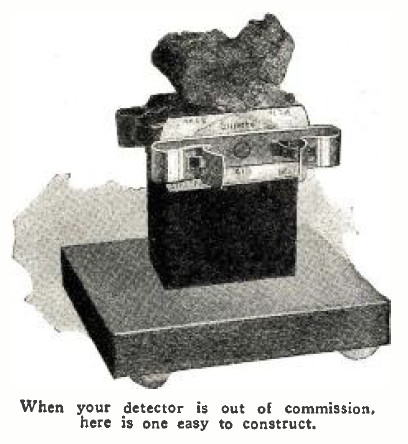
Emergency Crystal Detector
Razor blades were occasionally used to make radio detectors even before the invention of the foxhole radio, though not in the same way. This one, from the June 1925 issue of Radio News, uses two blades mounted upright – not the safest configuration – which are straddled by a chunk of "coke, carborundum or pyrites". The contact between the blades and the mineral function as a demodulator of radio waves.
It isn't exactly a foxhole radio detector, but it does show the same sort of improvisation that would lead to the razor-blade-and-pin detector. The Radio News detector more closely resembles a "microphone" detector, which either used a piece of steel – like a sewing needle – straddling two sharpened carbon edges, or else a small piece of carbon straddling steel edges. It is called the microphone detector because it resembles the microphones developed by David Edward Hughes in the 1870s. Hughes also discovered that his microphones could detect electromagnetic waves, though his findings were initially dismissed. The microphone as a detector of radio waves was more common in the early 1900s than the 1920s.