Saturday, June 29, 2019

WWII era Gillette blades

More blades that appear in black and white in the book, this time from Gillette. Caption is from the book.

The next post will cover all of the blades I tested in foxhole radios.

WWII era Gillette blades, top to bottom the camouflage military issue blade, the civilian “Thin Blade”, and the Blue Blade. All of these had a varnish coating. The camouflage blade is from 1944. This particular “Thin” blade is from 1935 and the Blue is from 1942 but both models were still in limited production throughout the War.

Previous:  More WWII era blades   Next: Blades tested in foxhole radios

WWII era razor blades

Here are some of the WWII era razor blades that appear in black and white in the book. The captions are from the book.

The post immediately following this one will cover Gillette wartime blades.

(Above) WWII civilian razor blades and their military issue equivalents. Gem produced a special “Armed Forces” box of five blades but the blade and wrapper were the same available in the civilian market.

WWII era Marlin razor blades. Two versions of the “camouflage” military issue blade, made by different manufacturers, top, and a civilian “Perfect Edge” blade sold in the blue version of the same packaging, second row left. The rest are “High Speed” blades made for Marlin by different manufacturers. Bottom left is the same model blade found in Paul Cornell’s radio. “Blu Srike”, “Durex” and a few other blades had the same slot shapes and all may have been made by Club.


Next: WWII Gillette blades

Thursday, September 6, 2018

Mystery Soldier


This is Photograph 111-SC-282168 U. S. Fifth Army Mobile Unit Programs Can Be Heard over Razor Blade Sets. 1945. Records of the Office of the Chief Signal Officer, Record Group 111. National Archives at College Park, College Park, Maryland. It is by far the best known photograph of a soldier with a foxhole radio at Anzio. It was taken for YANK magazine but never ran. 


The other photos in series with this one include the names of the subjects. But not this one. The note with the negative only gives the title. So far this soldier remains anonymous. I would prefer to include his name in the book, naturally, so if anyone recognizes him please let me know!

Wednesday, September 5, 2018

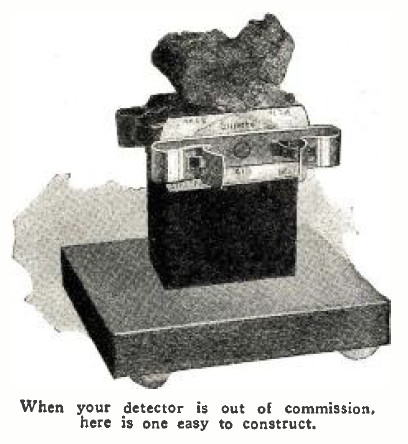
Emergency Crystal Detector

Razor blades were occasionally used to make radio detectors even before the invention of the foxhole radio, though not in the same way. This one, from the June 1925 issue of Radio News, uses two blades mounted upright – not the safest configuration – which are straddled by a chunk of "coke, carborundum or pyrites". The contact between the blades and the mineral function as a demodulator of radio waves.

It isn't exactly a foxhole radio detector, but it does show the same sort of improvisation that would lead to the razor-blade-and-pin detector. The Radio News detector more closely resembles a "microphone" detector, which either used a piece of steel – like a sewing needle – straddling two sharpened carbon edges, or else a small piece of carbon straddling steel edges. It is called the microphone detector because it resembles the microphones developed by David Edward Hughes in the 1870s. Hughes also discovered that his microphones could detect electromagnetic waves, though his findings were initially dismissed. The microphone as a detector of radio waves was more common in the early 1900s than the 1920s. 

Saturday, August 25, 2018

A potato by any other name

Researching foxhole radios and early radio wave detectors uncovers a lot of clever and strange equipment improvised by early radio amateurs. Like this radio wave detector made from a potato from the July 1915 issue of The Electrical Experimenter, invented by Milton Rochkind. As he explains it:

While putting up an aerial in my yard (80 feet long and 60 feet high) recently I tried to receive wireless messages. I took a potato and placed it on a box. Then I took two sewing needles. I took one needle and stuck it into one side of the potato. I then connected the second needle with one pole of the receiver and stuck it in the other end of the potato. I took the ground wire and connected it with the other end of the pole of the receiver, and when this was completed I was able to receive many messages just as clearly as from a detector.

The editor assumed the potato was acting like an electrolytic detector, a common detector of the era. I tried repeating the experiment but never got a signal. If anyone reading this manages to make a working radio from a potato I would love to hear about it. 

There were an amazing variety of radio wave detectors in the pre-crystal and vacuum tube days. They are well covered in Vivian J. Phillips' Early Radio Wave Detectors. Stevenage, Hertfordshire, England: P. Peregrinus in association with the Science Museum, London, 1980.

Thursday, August 23, 2018

I'm ready for my close-up

 If you've ever wondered what a razor blade looks like magnified 500 times, this is it. I was having it analyzed to see if there was any surface chemistry that would make it a good detector for radio waves. This is a WWII era "blue" blade. Despite popular folklore to the contrary, there was no selenium present. SEM image by Houston Electron Microscopy, Inc.


Here's the same blade at 75x.


The iron oxide is likely magnetite, which can act as a semiconductor. It is a thin enough layer that it allows some light to pass through, causing thin-film interference, similar to the surface of a soap bubble. This accounts for the subtle blue color of the blade.

Thursday, April 19, 2018

Progress!

Posts have been infrequent lately because I have been hard at work finishing the book! Stay tuned...